

Successful brands do the same thing. The ones that survive and thrive are often the ones that have carved out a specific, defensible place in the market—and in people’s minds.
And that’s what brand positioning is about.
What is brand positioning?
Brand positioning is how your business is perceived by your target audience relative to others in your sector. It’s the specific place you occupy in your customer’s mind—the set of associations and expectations that come up when they encounter your brand.
Volvo stands for safety. Patagonia is known for its environmental commitment. Neither of those associations was a coincidence. Both are the result of consistent, deliberate decisions over time—about what to communicate, what to charge, who to work with, and what to say no to.
Your logo, tagline, and mission statement are all expressions of that positioning, not the positioning itself.
Read more
For a range of examples sorted by positioning type, have a look at these 20 brand positioning examples and why they work.
Why you don’t need a positioning statement
If you’ve ever searched for how to come up with your brand positioning, you’ve almost certainly been told to write a positioning statement. The template usually looks something like this:
For [target audience], [brand] is the [category] that [unique value] by [how you deliver it], offering [key benefit] unlike [competitors] so that [audience] can [desired outcome].
For Volvo, that might read something along these lines:
For families and professionals who prioritise safety, Volvo is the car manufacturer that puts protection above performance by engineering every vehicle around collision prevention and survival—unlike brands that lead with speed or status—so that drivers can feel confident whatever the road conditions.
If you’re a brand manager at a multinational, this kind of statement is useful. It keeps thousands of employees and global agencies aligned. Though frankly, it would do that job better without the jargon.
If you’re a small business owner, just writing a positioning statement is the wrong goal. When you try to compress your vision into one of these fill-in-the-blank templates, the result is almost always clunky and lifeless. And it’s often interchangeable with what a competitor could come up with by filling in the same blanks.
The template is a tool, not the goal. What matters is the thinking behind it.
Your actual brand positioning isn’t a sentence in an internal PDF. It’s the clarity about who you are for, what gap you fill in the market and why someone should choose you. That clarity should then show up in every decision you make.
Instead of obsessing over your positioning statement, focus on answering three harder, more specific questions:
- Who is your ideal client, the specific person whose problem you were built to solve?
- What are your competitors missing about the market or your audience?
- Why should your audience trust that you get them? What do you give them that no one else can copy or claim with the same conviction?
When you can answer those questions, your positioning becomes your filter. It shapes how you price, what you post, how you write your website copy, and who you say no to.
Why brand positioning matters and what the data shows
Starting your own business is hard. According to an analysis of US Bureau of Labor Statistics data, around 20% of new businesses close within their first year. By year five, roughly half are gone. And by year ten, 65% have shut down.
You’re probably not surprised, but let’s look at the reason behind this.
Research by CB Insights, based on post-mortems of 431 venture-backed companies that shut down since 2023, found that 70% ran out of capital. Venture-backed startups are not small businesses, but the pattern is the same one.
So money matters, obviously. But the biggest problem was that these businesses never worked out why someone should choose them, or whether there was a gap in the market to begin with. And that’s a positioning failure.
A brand that’s positioned well knows exactly who it’s for, what it solves, and why it’s the better choice for a specific person with a particular problem.
This clarity makes your marketing easier, but it shapes every other decision too, from pricing and partnerships to the trends you decide not to follow.
Positioning needs to stay the same for years, and that consistency is what pays off. Salsify’s 2026 consumer research found that 68% of shoppers paid more for a product in the past year because they trusted the brand.
A brand positioning example from Marriott International
Marriott International runs over 30 hotel brands, which they’ve positioned strategically so they don’t compete with each other. Moxy, Aloft and W sell to three different audiences. They show how positioning dictates everything in a company, from the physical space to how it operates to its culture and its marketing.
Moxy Hotels—the boutique budget option
Target audience: Someone who treats a hotel room as a base. They’re there to get out, meet people, and make the most of their stay.
Positioning: Budget-friendly, but with the energy of a boutique hotel. Social and peer-to-peer rather than transactional.
How it shows up:
- You check in at the lobby bar and get your room key with a complimentary cocktail
- Rooms are small and the space extends into communal areas with arcade games, photo booths, and DJ sets instead
- Staff wear streetwear, not uniforms, and are cross-trained across the whole operation
Aloft Hotels—the design and tech-led mid-range option
Target audience: An independent, design-conscious traveller who wants something with more edge and culture than a standard mid-range hotel.
Positioning: Music-inspired and different by design. Social but not loud, mid-range in price and with a distinct aesthetic.
How it shows up:
- Mobile check-in and smartwatch room keys
- The W XYZ bar runs live sets from emerging local artists, not DJ nights
- The lobby blends workspace and social space
- Re:fuel, a self-serve food and drink counter open around the clock, replaces the traditional restaurant
W Hotels—the luxury option
Target audience: Someone who wants luxury that feels experience-led and culturally relevant rather than stuffy.
Positioning: W’s positioning is “Luxury, Liberated”, launched in 2023 and built out by Porto Rocha. It moves the brand away from flashy opulence towards something experience-led and more subtle.
How it shows up:
- Bold design, dramatic lighting, custom soundscapes
- The lobby is a destination in itself, not a transit zone
- The rooftop pool operates more like an exclusive day club than a recreation area
- Staff will arrange any guest request, as long as it’s legal
None of these brands is better than the others. Each made a deliberate trade-off. Moxy sacrifices room size for community. Aloft sacrifices mainstream comfort for cultural edge. W sacrifices accessibility for liberated luxury. That trade-off is what makes each of them strong.
For a small business, it works the same way. It could be a coffee shop that only sells flat whites, so commuters can just take it on the go. Or a photographer who only shoots business headshots, so every founder who needs one knows who to call.
The four components of a brand positioning strategy
No matter how you approach your positioning, four things typically need to work together for it to hold up. The first three are the questions from earlier, but this time we’re going to go into a bit more detail.
Understanding your audience deeply
Knowing your ideal client goes beyond demographics. The better you can answer these questions, the more specific and defensible your positioning becomes.
- What do they value?
- What keeps them up at night?
- What do they want to identify with?
- What do they believe before they find you, and what needs to happen before they’d choose you?
Read more:
This article explores why it’s important to identify your target audience.
Understanding your competitive landscape
Where are the gaps? Where is everyone in your category saying the same thing, and what assumption is nobody questioning? Dollar Shave Club looked at the razor industry and saw that every brand was competing on premium innovation that most buyers didn’t want or need.
- Where are your competitors all saying the same thing?
- What are they competing on that your ideal client doesn’t care about?
- What is an assumption in your category that nobody is challenging?
Defining a position you can own
What do you offer that no one else offers in the same way, for the same people or with the same conviction? This doesn’t have to be a product feature. It can be a method, a perspective, a depth of understanding for a specific audience, or a worldview that shapes how you operate. This also needs to align with who you are as a business, or it won’t hold up over time.
- What do you do that no one else does in quite the same way?
- What perspective or which values inform how you operate?
- Can you back this position up consistently?
Communicating it consistently
Positioning only works if it shows up everywhere. Consistency is what turns your positioning into your reputation. So it should shape your brand messaging, pricing, client experience, brand culture and everything else.
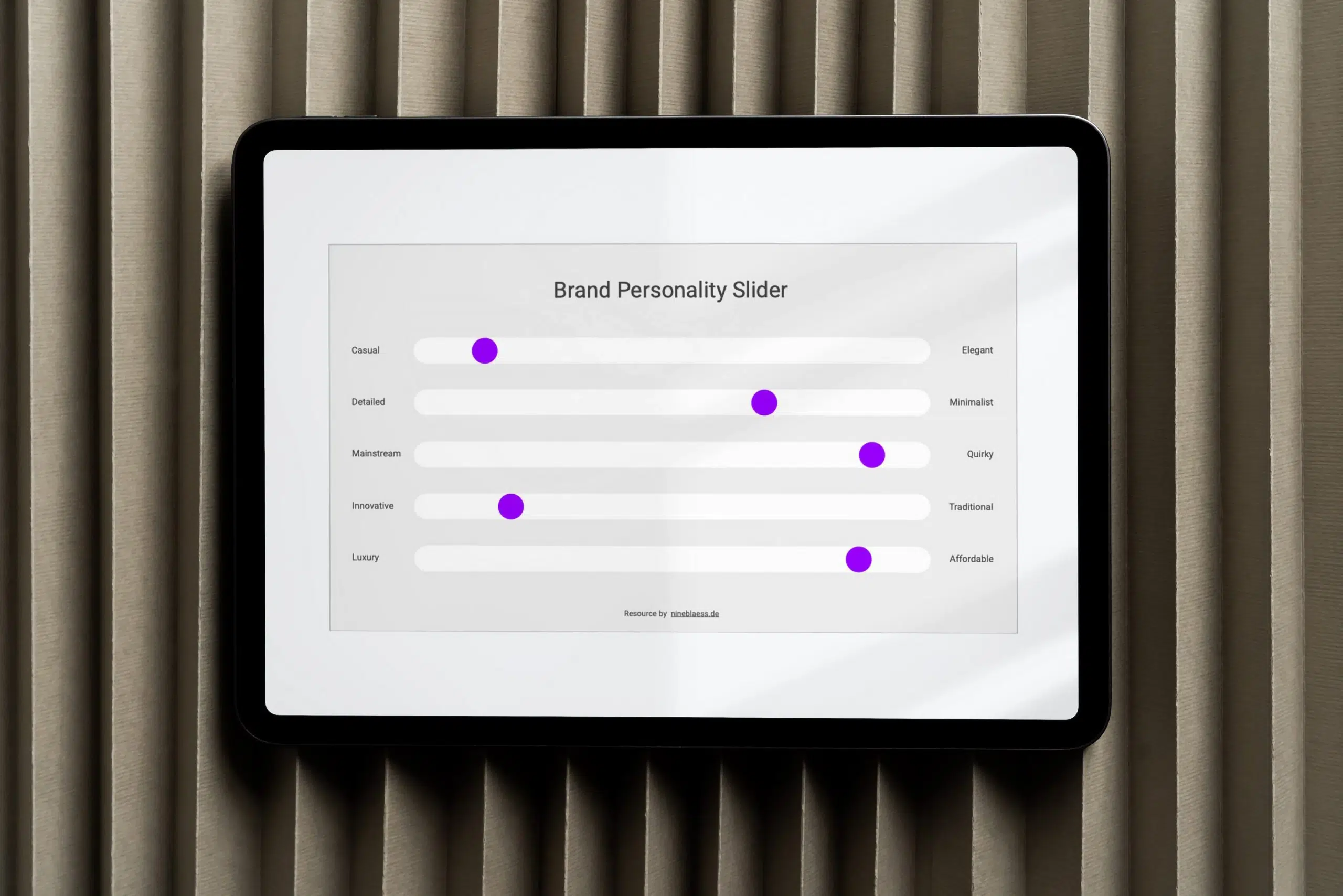
Your brand personality is what turns this position into something people can recognise, and it’s the basis for your brand voice, colours and fonts.
- Does your visual identity reflect your positioning, or just your taste?
- Does your pricing shape your brand perception?
- Does every brand touchpoint feel like it came from the same brand?
This is why positioning needs to be settled before the creative brand work even begins. And that’s why I start every project with brand strategy.
The most common brand positioning mistakes
Positioning your brand for everyone
The instinct to appeal to everyone is understandable, especially early on. But positioning that tries to speak to everyone usually ends up resonating with no one. The more specific your position, the more it attracts the people it’s built for.
The exception is if broad accessibility is your deliberate position, like a budget brand targeting the mass market. In that case, wide appeal is your strategy.
Positioning on features rather than meaning
Features can be copied. Meaning—like the specific worldview or values your brand is built on—is much harder to replicate.
The brands with the most durable positioning aren’t positioned on what they do, but on what they stand for.
For example, Tony’s Chocolonely didn’t set out to sell chocolate. Their founder, the journalist Teun van de Keuken, ate chocolate made with child slave labour and then reported himself, trying to force a prosecution. When that failed, he founded his own company to prove it could be done differently.
Claiming a position you can’t sustain
Positioning creates an expectation you should be able to uphold.
For example, Volkswagen spent years positioning themselves as a clean, efficient car brand, then got caught deliberately cheating emissions tests. The gap between claimed and actual destroyed trust overnight.
Honest positioning that reflects what you deliver will always beat aspirational positioning you can’t keep up.
Changing too quickly
Business owners tend to get tired of their own brand, often before their audience has really understood it. Changing direction every year or two means starting from scratch every time.
Take Nike. The brand has been saying the same thing since 1988, that greatness belongs to everyone, not just elite athletes. They never stopped finding fresh ways to say it. In 2012 Nike launched the Find Your Greatness campaign, timed to the London Olympics and built around an overweight boy jogging down an empty road in London, Ohio. Adidas was the Olympic sponsor that year, not Nike. Nike ran the campaign anyway and it’s the one we still remember. Five years later they launched the Pro Hijab.
That’s what consistency looks like. Saying the same thing in fresh ways, over and over again.
How brand positioning is changing
The core idea of brand positioning hasn’t changed since Al Ries and Jack Trout introduced the concept in 1969. But our world has shifted significantly.
You’re now positioning for both machines and people
Up until very recently, brand positioning was a human-to-human exercise. You carved out a specific spot in a consumer’s mind so that when they needed a solution, your brand name came up.
Today, finding a brand is increasingly handled by AI tools like Claude or Gemini that synthesise an answer. The brands they mention are the ones they can easily identify, verify, and position in their understanding of the market.
AI reads your brand differently than humans do
AI models organise the web by identifying entities—clearly defined people, organisations or services—and the relationships between them.
If your positioning is vague or inconsistent—if your website says one thing and your LinkedIn says another—AI can’t build a coherent picture of your brand and won’t reference it.
When your positioning is specific and consistent across your website and your published content, you become readable.
Small businesses have an advantage
AI-generated content has flooded every category. Large companies now produce massive volumes of polished, interchangeable copy. And readers are noticing. In fact, 32% of consumers say AI-generated marketing content makes them trust a brand less. A founder with a genuine perspective and a unique belief has something larger organisations with committees and sign-off processes cannot manufacture.
When your brand leads with that, you stand out to both audiences. For humans, you’ll sound refreshing. And for AI tools, you’re the kind of original source they like to cite.
When to revisit your positioning
Positioning isn’t permanent. Markets shift, audiences change, and a position that worked three years ago may no longer reflect where your business has gone.
A few signals it might be time to look at it again:
- You’re attracting clients who don’t feel like the right fit
- You’re having to over-explain your value in every pitch
- You’ve raised your prices but your brand still signals otherwise
- You’ve shifted your focus but your positioning hasn’t followed
A brand audit is a structured way to figure out the gap between how you want your brand to be perceived and how people actually see it—across strategy, messaging, and visual identity.
What now?
You don’t need a positioning statement to get started. Just get clear on who you’re for, what gap you fill, and why someone should choose you.
The kiwi doesn’t compete with the fantail. It doesn’t have to, because it hunts at night and the fantail during the day. It works the same way for your business.
If you want to see what strong positioning looks like across different industries and strategies, from personality-led positioning to weakness-turned-strength, you might like my article on 20 brand positioning examples and why they work.
You can work through all of this on your own. It’s just not always easy to get the distance you need to see the patterns. That’s what my brand clarity sessions are for. In 90 minutes I ask the questions, and you get a written document afterwards covering your positioning, your key messages, and what to build on and what to drop.
Frequent questions about brand positioning
Can I have more than one brand position?
No. Trying to hold two positions simultaneously splits your authority and confuses both human audiences and the AI tools that increasingly shape how new clients find you. Pick one defensible lane and own it completely.
That said, positioning strategies can overlap. You can be values-led and niche at the same time—a photographer who only shoots for sustainable fashion brands, for example.
How often should I update my brand positioning?
Check in with your gut every few months. Does it still feel right? Do a proper brand audit every few years, or after a significant market shift, like a major new competitor, a change in your offering, or a sense that you’re attracting the wrong clients.
Does brand positioning affect SEO and GEO?
Yes, more than most people realise. Search engines and AI tools don’t just rank content but entities. The more consistently and specifically your brand stands for something across your website, your profiles, and how others reference you online, the more clearly you show up as the obvious answer for a specific kind of question.
What’s the difference between brand positioning and branding?
Brand positioning is the strategic decision about where your brand sits in the market and in your audience’s mind. Branding—your logo, colour palette, typography and voice—is how that positioning is expressed. Positioning comes first, branding second.
On that note, you might also like my article about branding for small businesses.
What’s the difference between brand positioning and marketing?
Brand positioning is the strategic foundation. Marketing is how you reach people and communicate that position. Positioning comes first, then marketing amplifies it. Without positioning, marketing feels scattered, because there’s no consistent story underneath.
Title image by Unsplash+