

With so much generic, AI-generated content around, sounding more human is the only way to stand out. While most brands talk about what they do, they often fail to explain why it matters to people. Ultimately, even the best copy falls flat if nobody feels addressed by it.
To capture your audience’s attention, your brand messaging has to start with understanding how people decide. Here are the nine psychological principles I rely on to create a brand messaging strategy that earns trust and gets remembered.
1. Make it easy to understand
People don’t have time to work out what you’re trying to say. We all want the simplest answer, especially now that AI is filling our feeds with more and more information. So clarity isn’t just a bonus but the foundation of any brand messaging.
When your message is simple, people remember it and trust it. Psychologists call this ‘processing fluency’: the easier something is to understand, the more believable it feels.
Why simple messages feel more believable
Research by Light and Fernbach (2024) found that consumers see simple brands as less risky and more dependable. Clarity makes people feel safe, and a sense of safety is often what gets people to buy.
But there is a catch. The same research found that people are more likely to punish simple brands when something does go wrong. Simplicity works well for established companies that have proven themselves trustworthy, but it can be riskier for a new business, or in a complex category where errors might occur more often. So only promise simple where you can keep your word.
What I’ve learned
I often see clients worrying that using plain language will make them appear unprofessional or cheap. So they use jargon to justify their prices.
Having written lots of articles and copy myself, I find that making complex ideas sound simple is a real skill. Most of the time, when you can’t explain what you do to a ten-year-old, you’re overcomplicating things.
If this blog were written in academic corporate jargon, you would probably have switched off by now.
Example: Wise
Wise (formerly TransferWise) built its entire brand on simple, transparent money transfers.
Their slogan, “Money without borders,” says it all. Everything—from their clear pricing to the step-by-step process—is designed to reduce uncertainty and build immediate trust.
How to simplify your message
- Talk like a human. If you wouldn’t say it at a dinner party, don’t write it in your copy.
- Use active voice. Be direct. Choose clear, definite words that move your message forward.
- Avoid jargon. If someone outside your industry wouldn’t get it, simplify it.
- Write for people who skim. Use headlines and bullet points. Most people don’t read every word; they scan for what matters.
- Test your readability. Tools like Hemingway or Grammarly show you where something is hard to read.
2. Make people feel something
Clarity gets people to notice you, but emotion is what keeps them interested. Once someone understands what you do, they’re already wondering why it matters to them.
And the fact is, we tend to make decisions based on our feelings first and then use logic to justify them. Ultimately, emotion is how our brains find meaning and tell us what matters.
How emotion drives decisions
Research shows that emotion even determines how content spreads. Berger and Milkman (2012) analysed around 7,000 New York Times articles and found that content evoking high-arousal emotions—like awe, anger or anxiety—was much more likely to be shared.
But context matters too. What works for a viral news story may not work for your brand. For example, a study of messages posted during the pandemic found that happy posts were shared more often than angry ones. This shows that you need to match the emotion to your audience’s mindset.
What I’ve learned
I see a lot of businesses get stuck listing features like 24/7 support, premium materials, and so on—but forget to describe the relief a customer might feel when their problem is finally solved. Or how their life might be transformed with their product.
That’s why it’s never a good idea to just list what your product does. Show how it improves people’s lives by making them easier, calmer, more exciting or whatever else. Features still matter, though. People need them to justify a decision they’ve already made emotionally.
Example: Rautner 1808
That’s what I’m working on with the boutique accommodation Rautner 1808 at the moment. Rather than competing on price or room size, we’re focusing on the experience of staying there. The hotel sits between vineyards but within easy reach of the city, so there’s ample space to unwind without missing out on the city’s vibrancy. With the website copy, I’m drawing people into this feeling as if they’re already there.
How to use emotion in your messaging
- Lead with the transformation. Start with the result, not the tool. What changes for the customer after they choose you?
- Aim for the right value. Match your tone to what your audience cares about—whether that’s hope, pride, or simply the peace of mind that comes from solving a problem.
- Be specific. Vague emotional words sound like marketing fluff. Use details and stories to make the feeling genuine.
- Keep it ethical. Use emotion to highlight the value you provide, not to manipulate or create fear.
3. Frame your value the right way
Knowing that you are good at what you do is one thing. Explaining your value proposition in a way that others can immediately understand is quite another.
The way you present your message matters because people react to the way you say things, not just what you say. For example, saying you have a 95% success rate sounds much more reassuring than saying there’s a 5% failure rate, even though they both mean the same thing. This shows that framing can add perceived value to your offer.
Why framing changes everything
This effect was famously documented by psychologists Amos Tversky and Daniel Kahneman through Prospect Theory (1979). They discovered that people are more sensitive to losses than to gains. The pain of losing $10 is twice as intense as the joy of winning the same amount.
When it comes to brand messaging, showing what someone might lose—be it time, clarity or an opportunity—can motivate people more than listing facts or gains.
What I’ve learned
Many brands avoid talking about the cost of inaction because they don’t want to sound salesy. But if you ignore the frustration your customers already experience, such as wasted hours or constant stress, your offer won’t look like a genuine solution to their problems. And if it is the solution, you’re missing the chance to help them.
Another thing I’ve learned is that the way you present things should always reflect your brand’s personality. A witty brand can frame the same fact differently than a serious one. The wording that works for one would feel wrong for the other.
Example: Office Flower Solutions
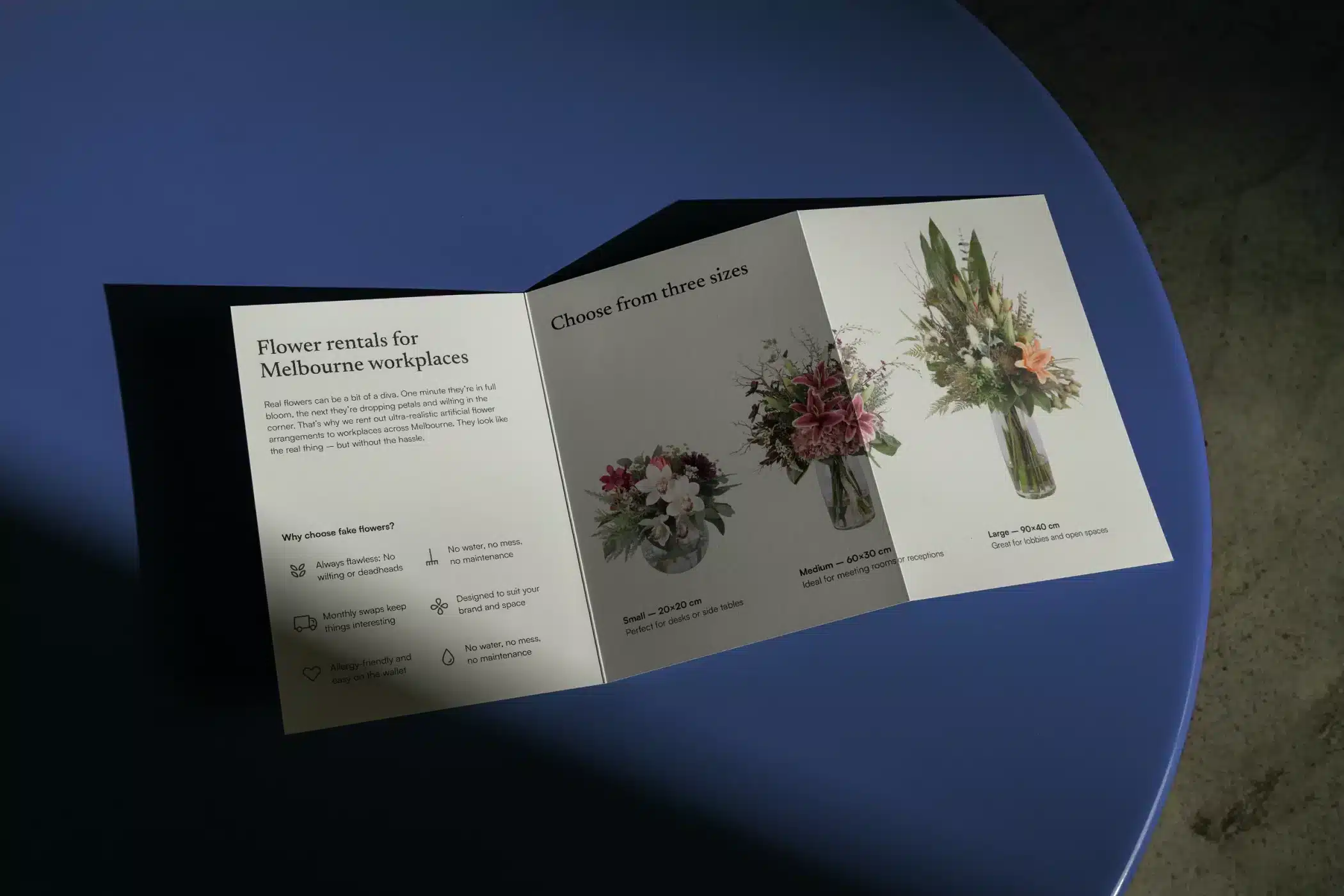
My client Office Flower Solutions rents out realistic artificial flowers. We began by asking the uncomfortable question: Why would anyone want fake flowers when they could have real ones for the same price? When we dug into this, we realised the value lay in the lack of hassle. Real flowers need constant attention.
Since the founder is an approachable, funny guy from the UK, we let his personality shape the messaging and embraced the truth with a bit of wit. “Real flowers can be a bit of a diva…”
How to frame your message for more impact
- Show both sides. Contrast the cost of staying stuck with the potential of moving forward.
- Remind people that inaction is still a choice. This usually results in lost time, money or growth.
- Visualise the transformation. Show a clear before and after.
- Empower, don’t scare. Use framing to make the stakes clear, but always ensure the next step feels like a positive move toward being in control.
4. Turn your message into a story
When we read a story, it’s not just words that our brains process. In fact, they simulate the experience. Neuroscience shows that stories activate the parts of the brain linked to vision, movement, and emotion.
This is why stories achieve what facts alone cannot. They lower our mental resistance. When we’re immersed in a story, we stop looking for reasons to object and start visualising our own transformation.
Why stories stick
- Memory: A classic study by Bower and Clark (1969) found that people who turned a list of unrelated words into a story recalled seven times more information than those who tried to memorise the list directly.
- Persuasion: Research by Small, Loewenstein, and Slovic (2007) showed that people donated twice as much when they read a personal story about a problem as when they were presented with cold statistics about it.
What I’ve learned
In my work, I often see business owners making themselves the focus of the story. They talk about their history, their awards or their processes.
I always tell my clients to make their customer the hero and their own brand the guide. Your role is to provide the tools and wisdom that will help your customers succeed.
Example: Nike
The tagline “Just Do It” isn’t about the technical specifications of a sneaker. It’s an invitation to join a narrative about grit, struggle and identity.
Nike puts the everyday athlete at the heart of this story. In doing so, it acts as a guide, providing the gear to help customers reach their potential.
How to use storytelling in your brand messaging
- Flip the script. The hero of your copy should be the person reading it, not the person who wrote it.
- Follow a story arc. Every good story has a clear structure: problem, journey, solution.
- Show the transformation. Rather than simply describing your service, show your audience what life will look like after they’ve used it.
- Keep it human. People can spot a marketing story a mile away. Use your real experiences and small details to build trust.
Further reading
If you want to dive deeper, check out my full article on brand storytelling.
5. Speak to identity, not just needs
We don’t just buy products or services—we invest in becoming better versions of ourselves.
Whether you want to become more confident, organised or creative, the things you buy often reflect your values and goals, and it’s no different for your clients.
How brands help us see ourselves differently
Research shows that when a brand’s personality aligns with how someone sees themselves—or how they want to be seen—it creates self-congruence (Sirgy, 2018). This fit is a strong driver of emotional attachment, and interestingly, matching who someone already is generally matters more than matching who they’d like to become (Malär et al., 2011).
Another study found that when a brand becomes part of a customer’s social identity, it becomes one of the strongest predictors of long-term loyalty. It’s not just about consumption anymore but about belonging and being part of a tribe.
What I’ve learned
In my design and strategy work, I always look for the real reason behind a request. For example, a client might ask for a professional logo, but what they actually want is to establish themselves as a serious player in their industry. In this case, a logo alone might not cut it.
When I develop brand identities, therefore, I am not just solving a practical problem. I’m helping the business to show who they are.
That’s where brand positioning comes in. It’s what makes you the obvious choice for a specific audience with a particular problem. If your brand message only addresses a functional need, your brand is easily replaceable. But if your audience looks at your brand and thinks “That’s me”, you’ve done a good job.
Example: Patagonia
Patagonia is the prime example of identity-based branding. The brand prioritises selling activism and responsibility over outdoor gear. Buying a Patagonia jacket sends a message about what you stand for.
How to align your message with identity
- Focus on the ‘who’, not just the ‘what’. Relate your message to the person your audience wants to become, not just the problem they need to solve.
- Present your product or service as a tool for growth. Show how choosing your brand can help people to express their values or reach their potential.
- Reflect their worldview. Use stories and visuals that show you understand their perspective.
- Keep it personal. Identity is human. Speak like a person, not a faceless company.
6. Build credibility through others
Trust rarely comes from what a brand says about itself. Instead, it comes from the experiences of others, such as experts, peers and real users. As social creatures, we are hardwired to use other people’s behaviour as a guide for our own decisions.
This is the power of social proof. If it worked for someone else, our brains assume it will work for us, too.
Why we trust others more than brands
The data consistently confirms this psychological bias:
- Peer trust: In Nielsen’s 2021 Trust in Advertising study, 88% of respondents worldwide trusted recommendations from people they know more than any other advertising channel.
- Authority bias: We are naturally wired to follow those we perceive as credible experts. When an authority endorses a brand, its reputation “rubs off” on the product—that’s the Halo Effect at work.
- Social currency: In his book Contagious (2013), Jonah Berger explains that people share things that make them look good. If your message gives someone something to be interesting with, it travels further.
What I’ve learned
All too often, social proof is treated as an afterthought and buried at the bottom of a website. I encourage my clients to use it in context.
Rather than simply displaying a collection of logos, explain how you solved a particular problem for that brand.
I also focus on the visuals. With AI capable of faking almost anything these days, a testimonial with an authentic photo and a LinkedIn link is worth ten anonymous quotes. Proof that’s clearly human is your most valuable asset.
Example: Airbnb
Airbnb’s entire business model is based on social proof. Instead of merely claiming that their stays are safe, they allow the community to prove it through verified reviews and host ratings.
By making social proof central to the user experience, Airbnb has transformed the idea of sleeping in a stranger’s house into a widely accepted concept.
How to build credibility
- Support your message with data. Show results, expert endorsements, or industry data to back up your claims.
- Let others tell your story. Feature case studies that focus on the transformation, not just the service you provided.
- Show visible engagement. Highlight community interactions to show your brand is active and trusted by others.
- Keep it raw. Avoid overly polished, corporate-sounding testimonials. Honest, human stories are much more effective than perfect marketing speak.
7. Let your brand be human, not perfect
While perfection may look professional, it often feels distant.
When every message is rehearsed, it starts to sound mechanical rather than human. Particularly with so much content being generated, ‘perfect’ can suddenly come to mean ‘untrustworthy’ or ‘fake’.
How imperfection makes you relatable
Psychologist Elliot Aronson’s Pratfall Effect (1966) explains this further. Aronson discovered that a highly competent person becomes significantly more likeable after making a small, harmless mistake, such as spilling a cup of coffee. This tiny slip-up makes them seem more human and relatable and less intimidating.
But the effect works the other way round for someone who hasn’t shown their competence yet. In the same study, the same mistake made an average performer less likeable. So being openly imperfect only pays off once people already know you’re good at what you do.
What I’ve learned
I see many creators and founders who are afraid to show their imperfect work. They hide their messy creative processes.
I’m not immune to that. I’ll spend an hour checking a single statistic. But I’m trying to let that go, especially in this blog. If everything I wrote were 100% polished, there’d be no point in reading it. You might as well ask Claude.
Example: Coffee Outdoors
Being human doesn’t have to mean being sloppy and unprofessional. Coffee Outdoors, an independent outdoor store here in Wellington, is actually quite perfectionist.
Their about page says they offer “the very best in what we specialise in without taking ourselves too seriously”, and you can feel the two founders behind it in everything they do. Every product is something they use themselves and meticulously selected, orders are packed with a little personal note, and when you enter the store, they offer you a coffee.
That’s what small businesses actually need. It’s not about making mistakes but being human.
How to humanise your messaging
- Don’t over-edit your content. Admitting to a small mistake or showing a bit of raw honesty makes you more relatable.
- Share the process, not just the result. Document your work in progress. People love to see these things.
- Show the people behind the brand: It’s easier to connect with people than with an abstract organisation.
- Write as you talk. Use a conversational tone that sounds like a person, not a press release.
- Embrace your learning curve. Don’t be afraid to share what you’ve learnt from setbacks. Transparency builds a type of trust that perfection never can.
8. Give first and build trust over time
Reciprocity is one of the most effective ways of building trust.
When you offer something genuinely useful without expecting anything in return, people naturally become more open to you.
How upfront value builds long-term trust
Robert Cialdini’s Principles of Influence (1984) describe this as reciprocity where people feel a pull to repay favours. What’s more, once someone makes a small commitment—like downloading a free guide—they are more likely to take a bigger step later in order to remain consistent with their previous actions.
What I’ve learned
I always tell my clients to focus on showing value first. For me, that means writing articles like this one. If you help someone solve a small problem for free now, they might remember you when they have a bigger problem in the future.
Example: Figma
Even before it became the industry standard, Figma offered a lot of value upfront. Its generous open design community and collaborative workshops made it easy for anyone to participate.
But over time, these low-pressure entry points turned casual users into loyal advocates who now wouldn’t dream of switching to a competitor. That’s also how they got me. I only tried Figma because I could use it properly without paying first.
How to build trust through reciprocity
- Lead with value. Share helpful insights, tools or resources before you even consider making a sale.
- Encourage micro-commitments. Focus on small, low-pressure steps. People like to be consistent in their actions.
- Use collaborative language. Invite people to join your process so they feel like partners rather than customers.
- Thank them. Expressing genuine gratitude for an interaction builds a stronger bond than most people realise.
9. Repeat your message to build familiarity
Our brains love familiarity. Things that feel familiar automatically seem more credible and less risky.
In psychology, this is due to the mere exposure effect, first documented by Robert Zajonc in 1968. The more often we encounter something, the more we tend to like and trust it. We’re usually unaware that familiarity alone is behind it. A related effect, illusory truth, goes a step further. Repeated statements start to feel more true, whether or not they are.
That’s why consistency pays off, and why you should only repeat things you can stand behind.
How repetition creates mental availability
Fazio’s (2015) research documents that the more often we are exposed to an idea, the more likely we are to perceive it as true.
In branding, this builds mental availability—the ease with which your brand comes to mind in a buying situation. Using consistent cues and distinctive brand assets creates memory structures that transform your brand from something unfamiliar into something familiar and trustworthy.
What I’ve learned
As a designer, I’ve noticed that business owners often become tired of their branding after a few months. They want to mix things up because they see their logo and colours every day.
But the thing is, your audience isn’t paying as much attention as you are. If you keep changing your core message and appearance, people have to relearn your brand every time.
The brands that stick do the opposite. They keep saying the same thing and only change how they say it, which is exactly what makes a tagline last for decades.
Example: Volvo
For decades, Volvo has based its entire existence on the idea of safety. Whether it’s a high-tech engineering stat or a heart-tugging family ad, the core message never wavers.
This relentless repetition has created very strong brand associations. In the consumer’s mind, Volvo is synonymous with safety.
How to build brand familiarity
- Find your core message. Incorporate it into every story, visual and brand touchpoint.
- Don’t change the message, change the delivery. Use new stories or different angles and formats to present the same core truth.
- Stick to the same cues. Keep your typography, colours, and tone of voice consistent. This helps people recognise your brand instantly.
- Give it time. Mental availability builds over years. Most brand owners give up before the repetition starts working because they get bored.
Last words
A brand messaging strategy is about understanding how people make decisions and communicating with them in an honest, clear and consistent way. At its core, it’s about helping people see that you can help them.
Now that anyone can produce polished content in seconds with AI, flawless writing is everywhere. But as machines become better at sounding logical, us humans are becoming more valuable for our ability to be unpredictable and draw on lived experience. AI can produce information at scale, but only people can nurture connections. When you embrace your quirks and mistakes, you can create a unique identity that no algorithm can replicate.
That’s when your message starts to resonate and influence how people feel about your brand.
Need help with your brand messaging?
As a brand strategist and designer, I help service-based businesses craft messaging that:
- Cuts through the noise
- Connects with your ideal clients on an emotional level
- Positions you as the obvious choice in your field
This starts with understanding the psychology behind your audience’s decisions and then translating that into a brand identity and messaging framework.
My services include:
- Brand strategy & positioning
- Messaging & copywriting
- Brand identity design
- Website design
Explore my services.
Or are you unsure what branding even involves? My guide to branding for small businesses covers the full picture—from strategy to visuals.
FAQ
What is brand messaging?
Brand messaging is how you communicate your identity, values and unique selling points through a consistent set of core ideas. It’s the themes and arguments you keep coming back to, and the tone you use to deliver them, so people know what you stand for without having to be told twice. It isn’t the stories that change with each campaign. Your key messages sit underneath and stay the same for years, so people can remember them and associate them with your brand.
What is a brand messaging strategy?
A brand messaging strategy is your plan for communicating your positioning to the outside world. It defines your value proposition, the key messages that carry it, who each one is for, and the tone you use to deliver them. Where your positioning defines what you stand for, the brand messaging strategy maps out how and where it reaches people.
How do you create brand messaging in the age of AI?
AI is designed to be an average of all data. Essentially, it’s a unified, safe opinion. To stand out, you can do three things:
- Embrace your flaws. Share lessons learned from projects that didn’t go as planned. While AI can describe struggles, it doesn’t have a personal stake in them.
- Avoid perfection. AI strives for perfection. Humans can build trust by showing their unpolished side.
- Have an opinion. AI lives in the middle ground. Having a unique perspective is the only way to stand out from the crowd.
Title image by Zen Chung